Most quality disputes in private-label footwear are not caused by bad factories. They are caused by a specification that was never written down, or was written down and then changed by email six weeks later. A checklist does not guarantee quality; it guarantees that both sides are talking about the same shoe.
1. Sign the specification sheet, not the sample photo
A photo cannot carry outsole hardness, lining composition, thread colour or insole thickness. The specification sheet can. Before production, both sides should hold the same document with the same values, signed, with a revision number and a date. Every change after that gets a new revision number, and nobody produces against a superseded sheet.
2. Confirm material test reports before cutting
Ask for reports on the exact material batch, not a generic certificate from last year. For EU markets the usual set is azo dyes, phthalates, and heavy metals; for the US, CPSIA lead content for children's styles. Reports take a week or two to obtain, which is why they must be requested before cutting rather than before shipping.
3. Check the first off-tool pair, not the last
The first pair off the line shows what the mould and the operator will actually produce. Compare it against the approved sample on a bench, in daylight, with the spec sheet beside it. Measure the sole thickness, the strap length and the insole. Photograph the pair and attach the photo to the production record — future disputes are settled by photos with dates.
4. In-line check at 30 percent
At roughly a third of the run, a second check catches drift: colour variation between batches of compound, stitching tension that has loosened, adhesive that has started to fail. This check is cheap and it is the one most often skipped when a factory is busy.
5. Needle detection and metal-free confirmation
For any style with a textile upper, needle detection is standard in export production and the record should be kept per carton. If your market requires a metal-free declaration, ask for it at the same time — it is a document, not a test, and it costs nothing when requested in advance.
6. Fitting check across the graded curve
Fit complaints concentrate at the ends of the size run, not the middle. Check the smallest and the largest size in the order, on a foot or a last, before packing. For kids' styles, check the smallest size with a thick sock, because that is how the shoe will actually be worn in winter.
7. Pre-shipment inspection and a packing audit
AQL 2.5 is the common standard for major defects, with AQL 4.0 for minor. The inspection should cover carton markings, size ratio per carton, barcode scan, polybag warning text and the carton drop test. Ask for the report with photographs of the opened cartons, not just the summary page.
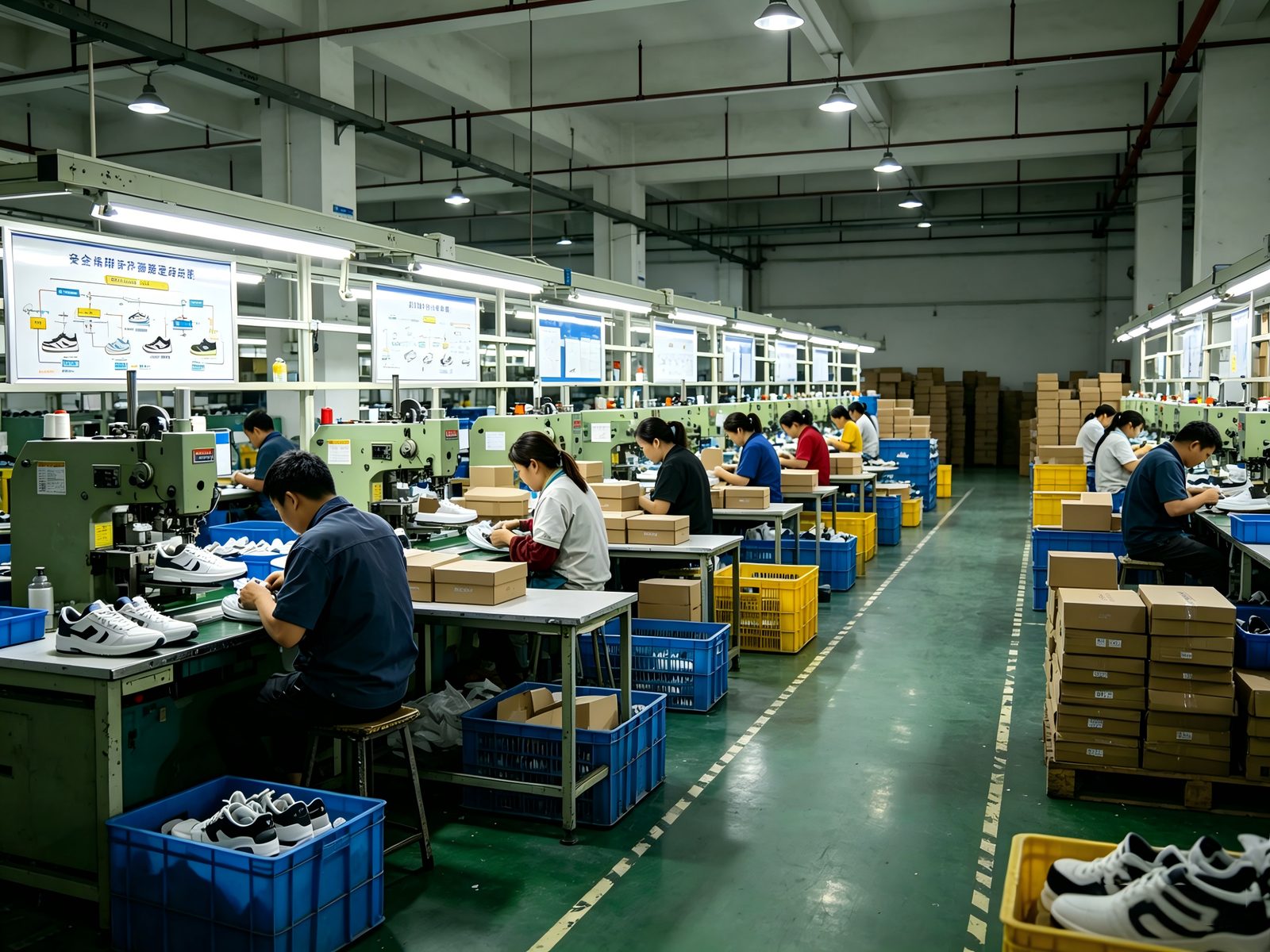
Our own factory and quality process is documented on the about page, and every style in the catalogue ships with the specification values that the inspection is measured against. If you want a third-party inspection, we accept most major agencies and will hold the container until the report is released.
What to do when the report shows defects
Decide before production what the remedy is: rework, replacement, or a price adjustment. Buyers who negotiate this at the inspection stage usually get a worse outcome than buyers who wrote it into the purchase order. The clause that works is simple — 'defects above AQL 2.5 to be reworked at supplier cost before shipment, with a re-inspection at supplier cost'.
FAQ
Can we inspect before shipment?
Yes. You can send your own inspector or appoint a third party. We ask for 48 hours' notice so the goods are packed and accessible, and we hold the container booking until the report is released.
Who pays for third-party inspection?
The buyer pays the agency. If the inspection fails on major defects, we pay for the re-inspection and for the rework itself.
What if defects are found after arrival?
Send photographs, carton numbers and the inspection report within 15 days of arrival. Claims that arrive with carton-level evidence are resolved quickly; claims that arrive as a statement without evidence take weeks. Our contact page routes quality claims directly to the production manager.