Quick Answer: A trial order is a measurement exercise, not a small order. With 600 pairs in one colour and one style, you test a mould, a print method, a packing spec and three markets before committing to a container. At 30 pairs per carton that is 20 cartons — enough to split across channels, small enough to absorb if a size run is wrong. Allow 25–35 days after deposit and sample approval, then read sell-through before reordering.
In this guide:
- What a trial order is actually for
- Why 600 pairs is the number
- One style, three markets: splitting the risk
- The trial order spec sheet
- Trial order vs full container
- How we cost this order
- Mixed containers: two or three styles in one booking
- What the 25–35 days actually covers
- Packing and carton maths
- Kids size runs: the 24–35 split
- Buyer mistakes with trial orders
- FAQ
What a Trial Order Is Actually For
Most buyers treat the first order as a purchase. We prefer to treat it as a test with a pass mark. A trial answers four questions a sample cannot: does the mould hold the artwork at production speed, does the colour stay consistent across a full run, does the packing survive a real carton, and does the size curve match how your market actually buys. A sample answers only the first, and only once. Write those four points into the purchase order as acceptance criteria, with an owner and an action for each. Then the trial produces a document, not an opinion. Our MOQ matrix explains why the minimum is set per colour rather than per order — the same logic that makes 600 pairs the cleanest unit of learning. We have run this for 12 years across 60+ countries and 500+ SKUs.
Why 600 Pairs Is the Number
Six hundred pairs per colour is not a sales threshold; it is a production threshold. A one-piece injection moulded EVA style needs a stable run to reach a steady colour and a repeatable mould temperature, and a very short run never settles. One-piece EVA moulding leaves no midsole seam and no glue line. Six hundred also divides cleanly: at 30 pairs per carton that is 20 cartons, and 20 whole cartons can be split three ways without opening a box mid-channel. Below that, you pay for changeover twice — once now, once on the reorder. Above it, you are buying inventory before you have sell-through data. It is the smallest quantity that behaves like a real order: one full colour batch, one complete packing spec, one QC record, and a carton mark you can trace to a production date.
One Style, Three Markets: Splitting the Risk
One style, three markets is the part buyers get wrong. The point is not to send the same shoe to three countries and hope. It is to hold the product constant so every difference in result comes from the market, not from the factory. One construction, one mould, one colourway, one packing spec — then vary the channel: a shelf, a catalogue, a marketplace listing, a resort shop. Keep the size curve identical at first, and record what sells by size, by week and by channel. If a printed kids rain boot moves in one channel and stalls in another, that is a placement finding, not a product finding — worth more than three different samples. Three readings on one specimen are what tell you what to reorder.
The Trial Order Spec Sheet
A trial order needs the same specification as a container, only shorter. Send it as one file, not a thread of messages. Five lines carry most of it:
- Artwork in vector form, with print position, print size and the exact colour reference.
- Construction and material: one-piece injection moulded EVA, or the agreed alternative.
- Size curve with pair counts per size, not just a range.
- Packing: one pair per polybag, 30 pairs per carton, carton marks and any hangtag or barcode.
- Acceptance points: what is checked, by whom, and the action if it fails.
One file means everyone prices the same object, and it is the definition of identical when the reorder arrives.
Trial Order vs Full Container
The two orders are not the same decision at a different size. Here is what changes between them.
| Decision | Trial order (600 pairs) | Full container |
|---|---|---|
| Quantity logic | Smallest stable colour run | Freight-efficient volume |
| Styles | One, or 2–3 in a mixed container | Many, planned from sell-through |
| Mould and print | Confirm the method and colour match | Reuse the approved standard |
| Packing | Lock polybag, carton count and marks | Repeat without changes |
| Lead time | 25–35 days after deposit and sample approval | Same, plus space booking |
| What it proves | Fit, colour, packing, channel demand | Reorder accuracy and cost |
How We Cost This Order
Here is how the desk on our side reads a 600-pair enquiry. First we check whether the artwork needs a new mould or can run on an existing one; that single answer decides most of the set-up. Then we choose the print method from the artwork, because a positioned print and a full-wrap print are not the same operation. Next comes the colour count, since the 600-pair minimum is per colour, not per style. We add the packing spec: one pair per polybag, 30 pairs per carton, plus whatever hangtag or barcode your channel requires. Freight is quoted on one of two bases, FOB Xiamen or EXW, and if the trial shares a container the carton count decides its share. We price it as the first run of a programme, not a favour: same mould, same QC, same packing record as the container that should follow.
Mixed Containers: Two or Three Styles in One Booking
Mixed containers are normal work for us, not a special request. A first order often carries two or three styles in one booking, which is how a buyer tests more than one idea without paying for a container of each. Keep each style at its colour minimum, and let the carton count allocate the space. Because packing is one pair per polybag and 30 pairs per carton, every style arrives in whole cartons — nothing is repacked at destination and nothing gets mixed inside a box. That matters when three markets read one shipment: a clean carton mark lets each channel report without opening another style's stock. Our guide to mixed versus full containers sets out the freight arithmetic in more detail.
What the 25–35 Days Actually Covers
Lead time starts when two things are true: the deposit is in and the sample is approved in writing. From that point, 25–35 days covers material scheduling, mould preparation, the production run, in-process checks, packing and the carton count before the boxes close. It does not cover artwork changes after approval, a colour re-match, or a revised size curve — each restarts a decision, not a clock. For a fixed date, send artwork and size curve together, approve in one round, and name the shipping basis early. FOB Xiamen and EXW are both routine for us; choose one before production starts, because the handover point changes who books space and who chases the container.
Packing and Carton Maths
Packing is where one trial becomes three comparable tests. One pair per polybag and 30 pairs per carton gives 600 pairs = 20 cartons. Write the split on the purchase order: eight cartons to one channel, eight to another, four to the third, with the same size curve inside each allocation. Each market then reports on a comparable carton. Ask for carton marks that identify the style, colour, size breakdown and production date before the boxes close. Put any hangtag, barcode or printed polybag in the same file; adding them later means opening 20 cartons. Send the packing sheet with the artwork and the quotation comes back on the real spec.
Kids Size Runs: The 24–35 Split
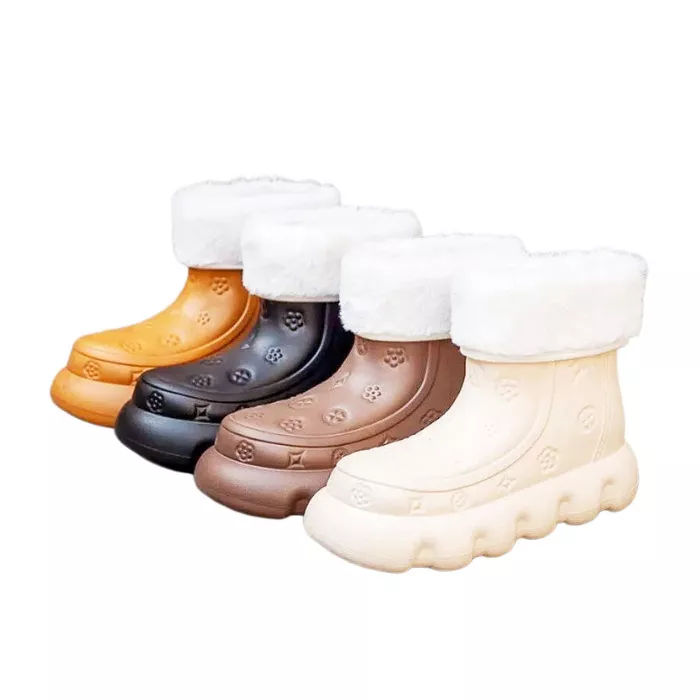
Kids orders add one decision adult slippers do not: the size run is split. Our kids range runs 24#–29# and 30#–35#, and a trial that orders only the middle sizes tells you very little about how a shelf actually sells. Decide the pair count per size before the mould is scheduled, and keep it identical across the three market allocations. A dense print that reads well on a 30# can look crowded on a 24#, so approve both ends of the run. See the kids series for our constructions and a lined kids snow boot for a seasonal spec. Twenty cartons is enough to see which band moves first.
Buyer Mistakes With Trial Orders
Four mistakes account for most disappointing first orders, and none of them start on the production line:
- Changing the artwork after sample approval, then treating the original lead time as fixed.
- Splitting 600 pairs across three colours — that is three colour minimums, and the run never settles.
- Ordering only middle sizes, which hides the size curve you came to measure.
- Judging the trial on two weeks of sell-through instead of one full selling period.
All four are cheaper to fix in the spec sheet than in a production run.
FAQ
Can a trial order carry more than one style?
Yes. Two or three styles in one mixed container is routine for a first order, provided each style reaches its own 600-pair-per-colour minimum. Keep the styles in whole cartons and the three markets can still report separately.
Is 600 pairs per style or per colour?
Per colour. One style in one colour at 600 pairs is a single stable run; one style in three colours is three separate runs. If you want to compare colourways, treat each as its own trial and read the sell-through before choosing which one to scale.
How long until the trial ships?
25–35 days after the deposit and written sample approval, on FOB Xiamen or EXW terms. Artwork revisions, a colour re-match or a changed size curve after approval all add time, because each restarts a decision rather than a clock.
Can we change the size curve after the sample?
You can, but record it as a revised spec with a new approval date. The kids ranges 24#–29# and 30#–35# need pair counts per size, not just a range, and changing them after mould scheduling affects both the run and the carton allocation.
What should we send to get a useful quotation?
Vector artwork, the target retail price, the size curve, the packing sheet and your shipping basis. From our office at Room 2103, No. 22 Xingqian Road, Jimei, Xiamen, Nicky Chen ([email protected]) replies with a mould recommendation, a print method and a landed cost.
Send the artwork and your target retail price and we will come back with a mould, a print method and a landed cost.