
Quick Answer: A red flag in a supplier reply is rarely a lie — it is a gap. No named port, no validity date, no packing basis, a price quoted before anyone asked about your design: each gap costs you money later. The clearest single signal is a reply with no questions in it. Our first answer to a real enquiry names the basis (FOB Xiamen or EXW), the 600-pair minimum per colour, and 25–35 days from deposit, in writing.
In this guide:
- What a red flag actually means
- Reply speed and who is answering
- Red flags and good replies, side by side
- A price before anyone asked about your design
- Vague answers on material and sizing
- MOQ and lead time that move when you push
- Tooling and sample fees with nothing on paper
- Certificates delivered as a folder
- How a good reply reads from our side
- How to write back to a weak reply
- Mistakes buyers make when reading replies
- FAQ
What a Red Flag in a Supplier Reply Actually Means
A red flag is not proof of bad faith. It is a place where the answer stops and the work begins, and it tells you how the next six months will run. Three kinds exist. The first is missing information: no port, no date, no packing line. The second is a contradiction — a claimed 500,000-pair monthly capacity in a reply written from a personal mailbox at midnight. The third is a reply that answers a different question than the one you asked. Read every reply as a sample of the working relationship. A supplier who cannot structure an email will not structure a production schedule.
Reply Speed, and Who Is Actually Answering
Speed alone proves nothing, but pattern does. A first reply inside one working day suggests enquiries are someone's job. A reply in four minutes to a detailed technical question, at 2 a.m. your time, suggests a template with your product name inserted. Look at the signature: a name, a company and a direct line means a person who owns the answer; a company name alone, or a free mailbox, means a relay. Ask one specific question: the second reply tells you more than the first. Anyone can send a catalogue; not everyone can answer why a seam sits where it does.
Red Flags and Good Replies, Side by Side
Five signals carry most of the information in a first exchange. None is conclusive alone; together they separate a factory that makes from one that quotes.
| Signal | Red flag in the reply | What a good reply contains |
|---|---|---|
| Price basis | A number with no incoterm and no named port | FOB Xiamen or EXW, stated, with the packing basis beside it |
| Design intake | A price before a single question about your artwork | Two or three questions on construction, colour count and target price |
| Material | "High quality EVA", no grade, no density | Construction named, plus what changes the cost inside it |
| Commitment | MOQ and lead time with no reference to deposit or samples | 600 pairs per colour, 25–35 days after deposit and sample approval |
| Paper trail | Tooling and samples discussed only in chat | A written quotation with validity date and payment terms |
A Price Before Anyone Asked About Your Design
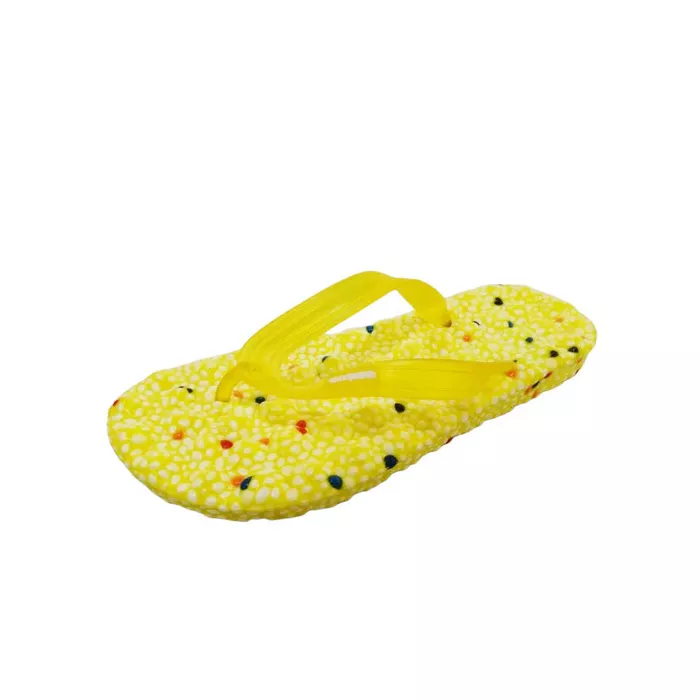
The most common red flag is also the most polite: a price in the first reply. A one-piece injection EVA slipper has a mould, a compound, a colour count, a print method, a packing format and a size run, and every one of them moves the number. A supplier who quotes before asking about any of it is quoting a product that is not yours — probably their bestseller, priced last season. Ask what the price assumes and watch whether the answer is a list or a sentence. The honest reply is slower and less satisfying: we need your artwork, your size range and your target retail price before the number means anything.
Vague Answers on Material, Construction and Sizing
"Good quality", "comfortable", "export standard" — three phrases that describe nothing you can inspect. Construction is where the difference hides. Ours is one-piece injection EVA: no midsole seam, no glue line, so there is no joint to fail and no adhesive batch to audit. A reply that cannot name its construction has nothing to say about field failures. Sizing is the same test. Ask for the size run in numbers, not adjectives: our kids models run 24#–29# and 30#–35#, and a supplier who answers "European sizes" has not answered. Take a garden clog as a specimen and ask three factories to describe it — the replies will not match.
MOQ and Lead Time That Move When You Push
Numbers that bend under pressure were never numbers. Test both. Ask for the minimum per colour and per style separately; if the answer is one figure covering everything, the supplier has not costed a colour change. Then ask what the lead time counts from. Twenty-five to thirty-five days is a real answer only when it starts at deposit and confirmed samples; otherwise it is a wish. Finally, ask what happens to both numbers on a repeat order with the same mould. A factory that has run your style before should commit harder the second time. Movement in either direction is the signal: a figure that shrinks when you push is a sales figure, not a planning one.
Tooling and Sample Fees With Nothing on Paper
A mould is the first real commitment in the relationship, and where paperwork matters most. Three questions, all answerable in one email: what does the tooling cost, is the sample fee deducted from the first order, and who owns the mould afterwards. A reply that answers them in chat but never in a quotation is telling you how disputes will be handled. Our own position is dull and deliberate: tooling and sample fees are quoted in writing, with the ownership question answered before payment, not after. If a supplier becomes uncomfortable at the word "ownership", that is the answer. The full reasoning sits in our note on mould costs and tooling ownership.
Certificates Delivered as a Folder
A zip file of certificates proves documents exist, not that your order is covered by them. Two checks separate the two. First, ask which certificate applies to which material and which market, by name. Second, ask whether the test house is third-party and whether the report names a factory and a date. A reply that sends a folder and no explanation has handed you the work of reading it. The same logic applies to capacity, countries or years in business: a number is a starting point, not an answer. Ask for the reference behind it, and prefer a short honest answer to a long impressive one.
How a Good Reply Reads From Our Side of the Desk
An enquiry reaches us in Jimei, Xiamen, and the reply is built in a fixed order, because the order is the answer. First the questions: artwork, size run, colour count, target retail price. Then the basis: FOB Xiamen or EXW, one pair per polybag, 30 pairs per carton, because carton count is what your forwarder prices. Then the commitment: 600 pairs per colour, 25–35 days from deposit and sample approval. Then the fit: 2–3 styles in a first container is normal for us, and a kids rain boot can travel beside an adult model without breaking the container. Twelve years, 60+ countries, 500+ SKUs and five million pairs are context, not a pitch — see the kids series for how a size run is presented.
How to Write Back to a Weak Reply
Most weak replies improve when the follow-up is specific. Skip "can you confirm?" and send a short list for a line-by-line answer: incoterm and named port, validity date, packing basis, MOQ per colour, lead time start point, tooling cost and ownership. Seven lines, one email. A supplier who answers all seven in one pass is worth a sample order, whatever the first reply looked like. A supplier who answers four and ignores three has told you where the risk will sit. Keep the exchange; the written record survives a change of salesperson. And if you are still deciding who to talk to at all, start with the seven-step check in how to verify a Chinese footwear supplier.
Mistakes Buyers Make When Reading Replies
Five errors account for most of the disappointment that follows a first order:
- Rewarding speed over structure — the fastest reply is often the one with the least content in it.
- Reading the price and skipping the basis — a number without an incoterm is not comparable to anything.
- Treating a catalogue as a capability — 500+ SKUs in a PDF says nothing about the mould behind your design.
- Not asking who owns the tooling — the answer decides whether you can move the product later.
- Ignoring the questions asked of you — a supplier who asks nothing cannot quote accurately, and will not be blamed for it.
Each of these is cheap to fix before a deposit and expensive after one. If a reply leaves you guessing, the contact page reaches Nicky Chen and the team directly.
FAQ
Is a slow reply always a red flag?
No. Factories quote in working hours and factory time; a detailed answer takes a day. What matters is whether the reply arrives with content. A fast reply with no specifics is weaker evidence than a slow one with seven answered lines.
Should I walk away from a supplier who quotes before asking questions?
Not immediately — ask what the price assumes. Some suppliers quote a standard model first and refine after. If the second reply still contains no questions about your design, colour count or target price, the price will not survive contact with production.
How do I check a claim about factory capacity?
Ask which lines run your construction, how many pairs per line per day, and whether a third-party audit covers that building. Then ask for a video call during production hours. A real number survives a follow-up question; an invented one usually becomes a range.
What if the supplier will not disclose tooling ownership?
Treat it as a price, not a mystery: assume the mould stays with the factory and that changing supplier means paying again. If that assumption is unacceptable, the ownership clause has to be written before the deposit, not negotiated after.
Is a certificate folder enough for compliance?
No. Ask which report covers which material and which destination market, who issued it, and whether the factory is named on it. A current report with a factory name and a date is useful; a folder of undated PDFs is decoration.
Send the artwork and your target retail price and we will come back with a mould, a print method and a landed cost.