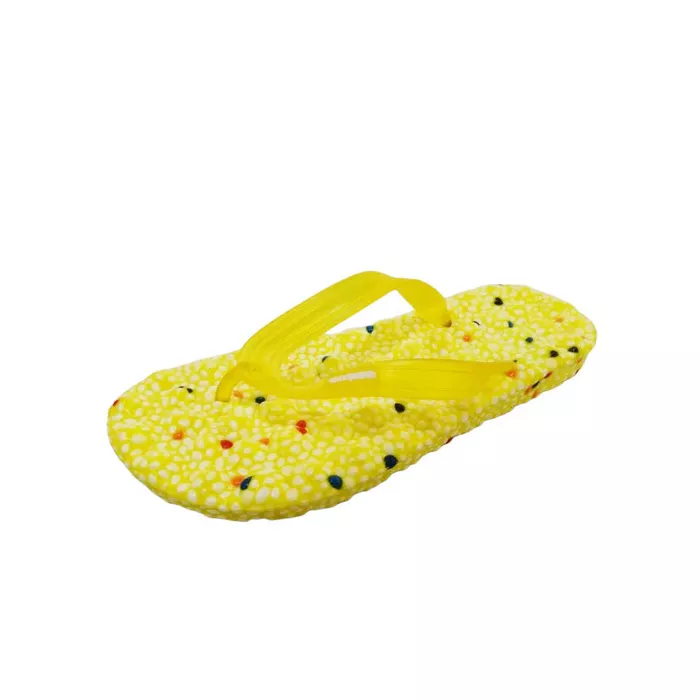
Quick Answer: A slipper order rarely fails on price; it fails on detail. Before paying any deposit, get written answers to twelve questions covering construction, MOQ, density, size split, print method, packing and lead time. On our line the answers are fixed: one-piece injected EVA with no midsole seam or glue line, MOQ 600 pairs per colour, one pair per polybag and 30 pairs per carton, 25–35 days from deposit and sample confirmation, FOB Xiamen or EXW. A supplier who answers all twelve in numbers is usually the factory. One who answers in adjectives is usually a middleman.
In this guide:
- Why twelve questions
- The questions at a glance
- Construction and MOQ
- Density, weight and price basis
- Size runs
- Artwork and print method
- Packing and cartons
- How we read a slipper enquiry
- Five buyer mistakes
- From artwork to shipment
- Choosing between quotations
- FAQ
Why Twelve Questions — and Why Slippers Specifically
Slippers look like the simplest product in footwear, which is exactly why vague quotations survive there longer than anywhere else. A slipper has no lacing, no last complexity and, in injected EVA, no separate sole to negotiate over — so a weak supplier can hide behind "yes, we can do that" for weeks. The cure is to convert the conversation into twelve specific questions, each of which forces a number, a material name or a written commitment. Ask them in the first exchange, and most of the gap between a reliable factory and an expensive lesson closes before you have spent anything. A well-organised casual series shows what those answers look like across a whole range, not just one style.
The Twelve Questions at a Glance
Here is the list in compressed form. The rest of this article works through each question — keep the table next to the quotations you receive.
| Question | What it decides | A clear answer sounds like |
|---|---|---|
| Construction | Where the shoe can fail | "One-piece injected EVA — no midsole seam, no glue line" |
| MOQ | Cash committed before the market speaks | "600 pairs per colour; 2–3 styles can share a trial container" |
| Density and weight | Comfort, durability, unit cost | A density figure and a weight per pair, in writing |
| Size split | Whether your market can buy it | "24#–29# and 30#–35# for kids; adult runs per your market" |
| Print method | How artwork survives wear | A named method matched to your artwork, not "printed" |
| Packing | Freight cost per pair | "1 pair per polybag, 30 pairs per carton" |
| Lead time and terms | Launch date and cash flow | "25–35 days from deposit and sample confirmation, FOB Xiamen or EXW" |
Q1–Q2: One-Piece Injection or Cemented — and MOQ per What?
Start with construction, because it decides where the shoe can fail. One-piece injected EVA forms the whole slipper in a single mould: no midsole seam and no glue line, removing the two points where slippers come apart. Cemented construction cuts a cheaper tool but reintroduces the glue line, and the glue line is where returns come from. Ask which one the quotation describes. Then ask what the real MOQ is — not a brochure number, but per what. Ours is 600 pairs per colour, and colour, not size, is usually the axis that sets the minimum. If the figure you hear has no "per colour" attached, ask again: it will reappear on the proforma invoice. We keep the full logic in our article on MOQ per style, colour and size.
Q3–Q4: Which EVA Density and Weight Is the Price Based On?
Two quotations for the same-looking slipper can differ by a wide margin for one reason: density. EVA is produced across a range of densities, and a denser footbed costs more per pair and outlasts a lighter one on the shop floor. Ask for a density figure and a weight per pair in writing, not "high quality EVA". Also ask what the price basis includes — FOB Xiamen and EXW are not the same number, and neither is "packing included" versus packing quoted later. A quotation that states construction, density, weight, packing and trade terms on one page takes ten more minutes to write and saves weeks. For how footbed construction changes the retail price point, see our guide to indoor slipper sourcing.
Q5: How Does the Size Run Split?
Size runs decide whether your market can actually buy what you ordered. For kids, our runs split into 24#–29# and 30#–35#, and each band drives carton ratios, shelf mixes and the minimum per size. Ask how many pairs per size the MOQ implies, whether odd sizes carry a surcharge, and how the size curve is set for your market — a Gulf order and a European order do not split the same way. Adults need the same treatment. A supplier who answers "we do all sizes" has not understood the question; a supplier who sends back a per-size breakdown has probably run this production before.
Q6: Which Print Method Will Carry the Artwork?
Printed artwork is where slipper quotations get quietly optimistic. Ask which print method the price assumes — a single-colour logo, a full-coverage graphic and a photographic print are three different processes with three different durabilities — and ask how the print survives flexing and washing, because a sidewall print on EVA lives a harder life than one on the footbed. Send artwork as vector files where you have them, and ask for a printed sample rather than a screen mock-up before the order. One more question worth asking: who owns the print artwork once the mould is cut. The answer should be you, in writing.
Q7: What Does the Packing and Carton Look Like?
Packing looks trivial until the freight invoice arrives. Our standard is one pair per polybag and 30 pairs per carton, which keeps pairs scuff-free in a mixed container and makes carton counts predictable at loading. Ask what the quotation assumes: polybag or box, hangtag or none, and how many pairs per carton — because pairs per carton is the single biggest lever on ocean freight per pair. If you sell retail-ready, ask who prints the barcode labels and where they sit on the polybag. Ask how cartons are marked, too: a container split across three wholesalers needs cartons a warehouse can route without opening.
How We Read a Slipper Enquiry on Our Side
When a slipper enquiry reaches our office in Jimei, Xiamen, the same sequence runs every time. We confirm the design works as one-piece injected EVA — some artwork needs re-engineering before any mould is cut. We count colours against the 600-pair minimum and check whether 2–3 styles can share a trial container to test the market. We quote density and weight, state packing as one pair per polybag and 30 pairs per carton, and put the lead time in writing: 25–35 days from deposit and sample confirmation, FOB Xiamen or EXW. Twelve years and 500+ SKU later, the orders that run smoothly are still the ones where all of this was agreed before the deposit — which is exactly what the twelve questions force.
Five Mistakes Buyers Make with Slipper Orders
- Buying on artwork alone. A beautiful render says nothing about density, construction or packing.
- Accepting an MOQ with no "per colour". The number will be redefined at the proforma invoice, and by then you have already shown your market the catalogue.
- Skipping the size-split conversation. A run that ignores your market's size curve turns half the carton into markdown stock.
- Treating print as one word. "Printed" covers three processes with three lifespans; ask which one is in the price.
- Booking freight before the carton is fixed. Pairs per carton changes the freight per pair more than the unit price does.
From Artwork to Shipment: What the Calendar Looks Like
Sample approval starts the clock, not the enquiry. The realistic sequence runs: artwork and questions in week zero; quotation and sample arrangement; sample approved; deposit paid; 25–35 days of production; FOB Xiamen loading or EXW collection. If your launch date sits inside that window, tell the factory the date, not just the quantity — a 600-pair trial that misses its season teaches nothing. First orders can combine 2–3 styles in a mixed container, which lets a slipper line share a container with other categories instead of waiting to fill 30 cartons of one SKU. Send us the enquiry with your launch date and we will tell you honestly whether the calendar works.
Choosing Between Quotations Once the Answers Come Back
Line the replies up side by side and the choice usually makes itself. A factory answer has numbers where a middleman has promises: construction named, density stated, MOQ per colour, packing counted in pairs per carton, lead time anchored to deposit and sample confirmation. Compare like with like — a ventilated garden clog and a plush faux fur mule can both sit in the casual series but are different engineering problems, so put the same twelve questions to both quotations. If one reply comes back materially cheaper with two questions unanswered, the missing answers are the price of the discount.
FAQ
Can I mix colours and sizes inside the 600-pair minimum?
The minimum is 600 pairs per colour, so colours cannot be mixed below that line. Sizes within a colour can follow your market's curve. What can be mixed at first order is the style: 2–3 styles can share a trial container, which is how most buyers test a slipper line before committing to a full programme.
What artwork do you need to quote a printed slipper?
Vector files where you have them, plus the target print area and the colours used. From that we can name the print method, quote it as a separate line and arrange a printed sample. A photograph of a competitor's shoe is a starting point for a conversation, not a basis for a quotation.
Is EXW cheaper than FOB Xiamen?
EXW removes the local charges from our invoice and moves them into your forwarder's bill, so the comparison depends on your freight agreement. Most buyers take FOB Xiamen because the container is already loaded in Xiamen; both terms are on the table for every quotation we issue.
Can I get a sample before committing to 600 pairs?
Yes. A sample from an existing factory mould is normally the fastest route; a new design goes through a printed or tooled sample first. Either way, approve the physical pair — not a photo — before the deposit, and expect one revision round to be worth its cost.
Do you produce kids' sizes?
Yes, our kids' runs cover 24#–29# and 30#–35#, produced on the same one-piece injected EVA construction as the adult lines. Kids' programmes also need a firm conversation about print durability and small-parts rules, so raise both with the first question.
Send the artwork and your target retail price and we will come back with a mould, a print method and a landed cost.